I. Preface
With the advancement of industrial technology, machine tools must meet diverse customer requirements for workpiece variety and various production conditions. Consequently, the demand for machine tool stability continues to grow. Whether influenced by internal mechanical components or external environmental factors, machining accuracy must be controlled within a specific range to meet manufacturing requirements.
Approximately 40% to 70% of machining errors in machine tools are caused by thermal displacement. During the machining process, heat generated by various components affects the final accuracy through thermal transfer. Therefore, high-precision machine tools are often required to be installed in temperature-controlled facilities to minimize structural deformation and accuracy errors caused by environmental temperature fluctuations.
Long-term machining stability is a key factor for customers. Machine tool manufacturers must understand the correlation between temperature changes and thermal displacement to evaluate machining accuracy under thermal deformation. Internal heat primarily originates from machine operation and the cutting process. Heat sources during operation include motors, bearings, and servo feed systems; heat during cutting is generated by the relative motion between the tool and the workpiece, as well as chip friction. These heat sources change the temperature across the machine via conduction, convection, or radiation, causing structural expansion and contraction. This alters the relative position between the workpiece and the tool, resulting in machining errors. Because thermal deformation has a significant impact on accuracy, a primary focus of machine tool technology development is the effective control of thermal displacement to enhance stability.
Victor Taichung (台中精機) has developed the "Lathe Thermal Displacement Compensation STD (Standard Version)"—an intelligent functional technology specifically for CNC lathes. By considering the heat generation and thermal transfer behavior of all machine components, a comprehensive structural thermal displacement compensation equation was established. This system compensates for structural displacement through axial movement. This not only reduces the frequency of manual offsets required by operators but also effectively improves machine accuracy stability and overall efficiency.
II. Features of the Thermal Displacement Compensation STD Version
Description
The Thermal Displacement Compensation STD function was developed using Finite Element Method (FEM) software simulations (Figure 1) conducted on in-house CNC lathes. This was paired with extensive real-machine thermal displacement measurement data and workpiece dimensional change charts (Figure 2) to confirm the direction and trend of structural thermal displacement over time.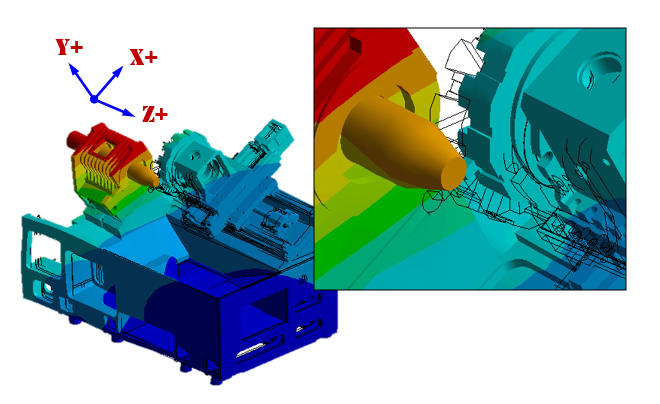
Figure 1: FEM analysis results of overall structural thermal displacement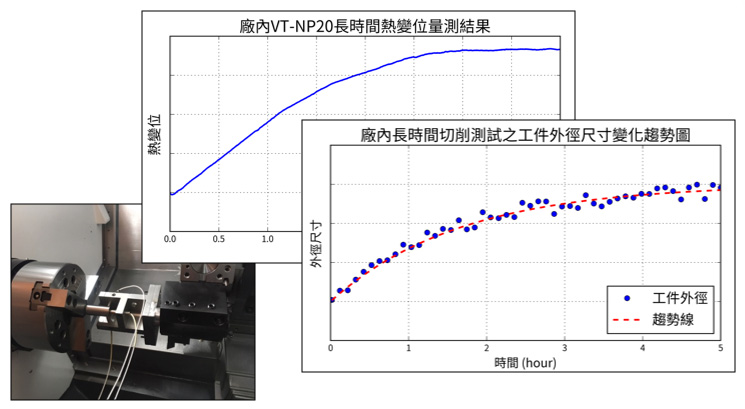
Figure 2: Long-term thermal displacement measurement and cutting test results of an in-house CNC lathe
The relationship between lathe thermal displacement and changes in cutting workpiece dimensions is shown in Figure 2. The results indicate that the thermal displacement measurement trend closely mirrors the change in the outer diameter (OD) dimensions. This suggests that the relative displacement between the tool and the workpiece causes them to gradually move apart. This process can be divided into two stages:
1. Stage 1: Transient Dimensional Change (First 3 hours): Primarily influenced by the transient, short-term heat generation and deformation of moving parts, including the spindle and axes, causing more drastic changes in machining accuracy.
2. Stage 2: Steady-State Dimensional Change (After 3 hours): Influenced by the slow heat transfer through the entire machine structure and the deformation of the structural base due to external environmental heat sources.
The Thermal Displacement Compensation STD Version integrates the results of the aforementioned simulations, measurements, and cutting tests to establish a comprehensive thermal displacement equation. It estimates the relative displacement between the tool and the workpiece without the need for additional sensors. This value is then inverted and input into the CNC controller as a compensation value, driving the corresponding axial movement to maintain accuracy.
Regarding the compensation mode:
•In Stage 1 (Transient): A short-term compensation control mode is adopted with high-frequency adjustments to maintain workpiece accuracy during rapid changes.
•In Stage 2 (Steady-State): The compensation frequency is lower, applying gradual adjustments to counteract the slow thermal deformation of the structure.
In-house tests comparing the presence and absence of the STD compensation function are shown in Figure 3. Without the function, the OD dimension gradually increases over time; with the function enabled, the workpiece size is effectively controlled within a specific range, significantly improving stability.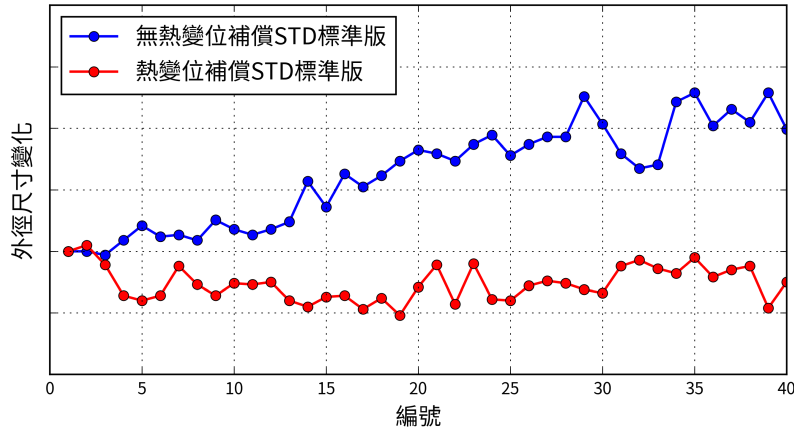
Figure 3: Comparison of verification results with and without Thermal Displacement Compensation STD
III. Client Application Case
After verifying the machining accuracy and stability of the STD function through internal testing, various machining scenarios were tested at customer sites. The results for outer diameter (OD) machining are shown in Figure 4. The results are consistent with internal tests: without the function, the OD size increases over time; with the function enabled, the OD remains stable over long periods. This demonstrates that the STD version effectively compensates for the total thermal displacement of CNC lathes and maintains long-term stability.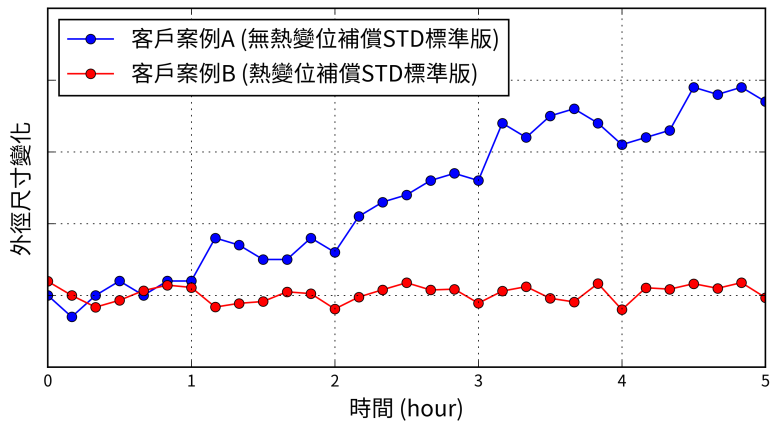
Figure 4: Comparison of client-site verification results with and without Thermal Displacement Compensation STD
IV. Conclusion
Victor Taichung possesses a professional R&D technical team, supported by computer simulations and precision measurement equipment, to continuously develop intelligent technologies. Our goal is to enhance the long-term stability of machining accuracy. Through the research and application of the "Lathe Thermal Displacement Compensation STD (Standard Version)," we aim to reduce the frequency of manual operator corrections, thereby increasing the value of overall machining efficiency, product quality, and output for our customers.
CNC Lathe Thermal Displacement Compensation STD (Standard Version)
Functional Introduction and Practical Applications
2026/04/14